CoAction Solutions
ISO 9001 has always had the potential to be more than a route to certification. Used with intent, it can help an SME understand how the business really works, make better decisions and deliver consistently for customers.
For me, ISO 9001:2015 marked an important change in direction. Its process approach, risk-based thinking and stronger focus on organisational context encouraged businesses to look beyond procedures and consider how connected activities, people and decisions contribute to results.
It also placed clearer responsibility on leaders, gave greater recognition to organisational knowledge and made integration with other ISO management system standards more straightforward. Together, these changes supported a more joined-up view of the business. This view recognises how customers, employees, suppliers, technology, finance, environmental pressures and strategic choices influence one another.
The 2026 edition builds on that foundation rather than replacing it. It was published in September and reflects the more demanding environment in which SMEs now operate. Greater uncertainty, changing stakeholder expectations, growing customer interest in responsible conduct and the need to embed quality in culture as well as process characterise that environment.
I am particularly pleased that the Introduction continues to present a quality management system as a strategic decision. It describes the benefits as improved performance, customer satisfaction, sustained success and sustainable development. That matters because it reinforces a principle at the heart of my work: ISO 9001 should support the wider direction of the business, not sit apart from it.
I would summarise the significant developments as follows:
Some may argue that those who design a management system well should already address much of this. That may be true. In practice, however, people can overlook expectations that are not explicit or treat them as optional. I therefore welcome the stronger emphasis.
These refinements may appear modest, but their influence reaches across the management system. They encourage SMEs to connect quality with culture, resilience, responsible business and strategic direction. In doing so, they make ISO 9001 more useful as a practical framework for sustainable, long-term improvement.
This is not about choosing between responsible business and commercial success. The two should reinforce one another. A business that understands its stakeholders, learns from experience and improves how it operates is better placed to earn trust and retain customers. It can also respond more effectively to change.
Quality management begins long before an SME decides to pursue certification. It starts with understanding what good performance looks like, creating reliable ways to achieve it and learning continuously from experience. Certification may recognise that discipline. The real value, however, comes when leaders and their people apply it in the decisions they make every day.
That is why I welcome the stronger emphasis in ISO 9001:2026. Its focus on culture, values, ethical behaviour and opportunity-based thinking reflects how organisations actually succeed. Procedures remain important, but quality becomes real through everyday action. It is evident in the choices people make, the concerns they feel able to raise and the improvements they pursue together.
The challenge is to avoid treating ISO 9001:2026 as another compliance exercise. You may already be certified, be considering certification for the first time or want to explore the benefits of Quality-Led Management. In each case, use it as an opportunity to involve your people. Test whether your system reflects how the business genuinely works, then identify where it can create greater value.
This is why I continue to promote ISO 9001 as a business management framework. Leaders should not treat it as a system owned by the quality department. Used thoughtfully, it can support excellent customer experiences and stronger commercial performance. It can also contribute to a more sustainable future for all.
If you would value a practical conversation about where to begin, please get in touch.
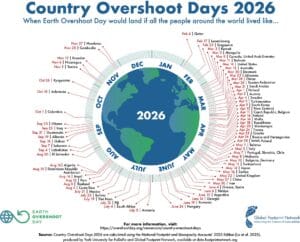
Earth Overshoot Day marks the point when humanity’s demand for ecological resources exceeds what Earth can renew in that year. This year, the date falls on 30th July 2026.
According to the Global Footprint Network, humanity is currently using nature 73% faster than Earth’s ecosystems can regenerate, which is equivalent to using around 1.73 Earths.
Although 30th July is the global date, it varies from country to country. The image shows this difference and is provided courtesy of the “Global Footprint Network -www.footprintnetwork.org and www.overshootday.org.”
It is easy to see this as a climate story. However, while climate change is part of it, Earth Overshoot Day is wider than carbon.
It points to the pressure we place on land, water, forests, food systems, materials, biodiversity and the natural systems that absorb emissions and regenerate the resources our economy depends on.
If Earth Overshoot Day tells us anything, it is that business cannot separate long-term success from the systems it depends on. That does not mean every SME needs a large sustainability department or a complex reporting framework. It means owners and leaders need a clear view of the resource pressures around them and a practical plan for improvement.
For business owners and leaders, Earth Overshoot Day is useful because it gives you a reason to step back and look at the bigger system around your business. Where are you exposed? Where are you wasteful? Where do you depend on scarce resources, fragile suppliers or inefficient processes? Where could better decisions protect value?
Responsible business is often presented as a matter of compliance or reputation. Both can matter, but they are not the whole story. At its best, responsible business helps you run a stronger organisation. It reduces avoidable cost, improves control, supports better planning and builds confidence with the people who matter to your business.
For most SMEs, the response needs to be proportionate. That means starting with the issues most relevant to the size, activities, risks and resources of the business. It is not about copying corporate reporting models or creating paperwork for its own sake. It is about taking practical, credible and proportionate steps that fit the business, support better decisions and can be improved over time.
A useful first step is to ask yourself a few practical questions:
Once you have identified a priority, choose one area of the business where resource use, waste or supply chain risk is visible. Establish a simple baseline. Decide what better would look like. Take action. Review the result. Then adapt and improve. This learn, adapt, improve approach keeps the work realistic and turns sustainability from a separate project into part of how the business operates.
Earth Overshoot Day reminds us that resource use is no longer a background issue. For SMEs, it is also an opportunity. Businesses that use resources more wisely, reduce avoidable waste, strengthen governance and build improvement into everyday routines can become more resilient, more trusted and better prepared for the future.
If creating sustainable success seems like a good move for your business, why not book a free 30-minute discovery call? We can talk through where you are now, what pressures matter most, and what a proportionate next step could look like.
P.S. In the interest of transparency please check out the following links that will provide you with far more explanation than I can do in a simple post.
https://data.footprintnetwork.org/#/ (that provides an interactive view for ecological deficits and so much more)
As the year draws to a close, I find myself reflecting not only on the year that’s ending, but on the one quietly waiting ahead. Each year teaches us something if we choose to listen.
This year, those lessons arrived through conversations with family, customers, time spent listening to other businesspeople, insights from research, and books such as The Solutionist (Solitaire Townsend), The Infinite Game (Simon Sinek), and Green Swans (John Elkington). Different voices offered different perspectives, yet a common thread ran through them all.
Technology empowers, accelerates, and supports us, but it is people who build trust, create meaning, and sustain success over time. By embracing a genuinely human approach, we can design transparent, respectful, and supportive systems where expertise is shared responsibly and growth is nurtured sustainably.
As Simon Sinek so simply and powerfully puts it:
“Regardless of technology or speed of innovation, people are still people. And all the rules of humanity still apply.”
This belief sits at the heart of what I think of as Evolving Sustainable Success, but more of that and ISO Standards in 2026.
For now, sharing a sense of grounded optimism feels more important than ever, especially as when headlines suggest that things may get harder before they get easier.
It’s hard to ignore the drumbeat of negative news dominating the media. Yes, 2025 was a difficult year for many, and 2026 may bring its own challenges. But disinformation about climate change, sustainability, and blanket narratives like “many businesses will be in survival mode” drain confidence, especially for small and micro businesses already operating with tight margins.
But what concerns me most isn’t an honest discussion of challenges, but blanket narratives that leave no room for resilience, creativity, or progress. It’s times like these, perspective and context matters more than prediction.
While difficulties grab attention, positive change rooted in collaborative, human approaches often unfold more quietly and deserve amplification.
A few examples of inspiring businesses in the South West who work in this way are
Not forgetting to mention the hard work of volunteers in community groups pushing upward from the grassroots.
Or The 89% Project a global entity that helps no end if you are feeling isolated or question whether sustainability in business is worth pushing for.
Their work is a reminder that meaningful progress is happening all around us, often away from the spotlight yet powerful reminders that we need change that works.
But its worth remembering that not everything happens overnight. Progress moves slowly because it requires patience, investment, and a willingness to look beyond short-term gain. Still, the intent is real, the movement is visible, and there are genuine reasons to remain hopeful.
More businesses are operating in genuinely human-centred ways, proving that people-first doesn’t mean performance-last. Technology can accelerate and support us, but it is people who build trust, create meaning, and sustain success.
When uncertainty rises, retreat can feel like a natural instinct. Marketing budgets often disappear first. Collaboration starts to seem risky. Immediate pressures push long-term thinking aside. But withdrawal rarely creates stability.
Right now, we as businesses need more of the good stuff:
Above all, we need optimism that is honest rather than naïve, rooted in reality, shared purpose, and mutual support to build resilience.
As Christmas approaches, we reach a natural pause before the new year. A moment to breathe, reflect, and reset. Yes, 2026 may bring challenges. But it will also bring opportunity and by resisting overly negative narratives, supporting one another, and keeping people at the centre of how we work, we can build something far stronger than survival.
Together, we can build resilient, sustainable growth. The future is bright, and the most constructive approach is to keep reaching for the stars, not through wishful thinking, but through continual improvement. That’s why a mindset of continuous improvement maps so naturally onto sustainability in business.
This perspective is not theoretical, it comes from a collaborative approach based on decades of combined experience spent in customer-focused roles, reinforcing the belief that optimism, resilience, and sustainable growth are achievable when people remain at the centre of business.
Just a little something to consider given in the spirit of the season before we step into a new year with hopefully a quiet kind of optimism.
If you’d like to learn more, please contact us to arrange a Free 45-minute consultation. Together, we can explore whether we’re the right fit to help you build strong foundations for the future.
Lastly, we at Coaction Solutions simply wish everyone who takes time to read this a
Very Merry Christmas and a Happy New Year.
Wessex House, 66 High Street, Honiton, EX14 1PD