
CoAction Solutions
 In our last post, I described ESG as a practical way of thinking that helps businesses build credibility, resilience, and long‑term value. Here, I’ll show how SMEs can put that into action without adding unnecessary complexity.
Before going forward, it is important to recognise the significant contributions of sustainability professionals who have advanced environmental, social, and governance practices over the years. Their specialised knowledge continues to be invaluable, whether their focus is on climate change, decarbonisation, or sustainability reporting.
However, there are many ways to address the subject of sustainability in business, and it is essential all are explored and considered if businesses in the South West and beyond are to keep making a positive impact on the society and environment in which they operate.
ESG is most effective for SMEs when integrated into leadership, management, and continuous business improvement of a business. Bringing together several governance and management approaches to operationalise ESG:
Bringing what matters together over time so:
“Good governance sets the scene, and Leadership brings it to life to enhance performance."
That means building a business people want to work for and a delivery system that gets products and services right first time, every time, resulting in better customer experiences today, and stronger customer retention tomorrow.
Start by adopting a systems thinking approach to evaluate your current and future risks and opportunities, which results in a structured and flexible process for developing your Sustainable Development Strategy. Which achieves the goal of embedding ESG, improving performance and paves the way for long-term sustainable success..
If ESG still feels confusing, burdensome, or disconnected from day‑to‑day reality, it’s time to reframe it. So, please get in touch to explore how Coaction Solutions can help turn ESG from noise into genuine strategic value
 When we first introduced the phrase Evolving Sustainable Success, we believed it would spark conversations about how SMEs can engage with sustainability in ways that would strengthen their businesses.
But to be honest, without these conversations it doesn’t clearly communicate the practical business challenges we help organisations solve. Without that clarity, some businesses who weren’t inspired to contact us, may have missed opportunities to enhance resilience, reduce risk, and unlock long-term value which may have manifested itself in
Recognising this and staying true to our own commitment to continuous improvement, we evolved our positioning.
We now emphasise Driving Excellence through ISO Standards, because these services and research into sustainable development, originally inspired the phrase. This shift not only clarifies “what we do,” but creates the space to explain why Evolving Sustainable Success matters, and how it directly benefits your business.
At its core, this approach rests on three interconnected principles that help you rebuild, strengthen, or enhance your business.
You continuously improve, adapt and innovate.
As you learn from experience, from nature, and from change itself, your business becomes more resilient over time. At a pace that aligns with your priorities.
You create value that lasts.
By integrating ESG principles (or, if you prefer People, Planet, Profit) you move from short-term fixes to balanced, strategic growth that stands up to stakeholder scrutiny.
You treat success as a journey, not a milestone.
Driven by leadership and accountability, this approach builds a system that delivers meaningful, measurable value for your organisation and everyone connected to it.
Today, sustainability and growth are increasingly inseparable, even for SMEs, pressures are rising from all sides:
Failing to keep pace affects more than compliance; it affects reputation, profitability, and long-term viability.
Conversely, businesses that evolve proactively, build trust faster, reduce risks earlier, and seize growth opportunities sooner.
The strength of Evolving Sustainable Success lies in its flexibility. You can tailor it to your goals, your budget, and your stage of growth. This makes improvement not only achievable, but strategic. For instance, it may involve:
By addressing these needs through the lens of Evolving Sustainable Success, you gain clarity, consistency, and confidence in your operations. This approach offers measurable improvements that translate directly into smoother processes, stronger relationships, and better decision-making.
While our services focus on ISO Standards, Evolving Sustainable Success allows us to develop adaptive and sustainable solutions, driven by purpose and stakeholder-value.
So, whether you are working toward ISO certification, or developing long-term Sustainable Development strategies. Our goal remains the same.
To help build organisations that are resilient, respected, and ready for the future.
In a world defined by uncertainty, complexity, and rapid change, success can no longer come at the expense of people or the planet. It must evolve, intentionally and intelligently, alongside the realities of our environment, society, and economy.
This is why we champion ISO Standards. They are not checklists or tick-box exercises. They are frameworks for excellence, that lift performance, embed sustainability, and create long-term competitive advantage.
Ultimately, Evolving Sustainable Success is simply a fresh perspective on engaging with sustainability in business that links responsible business practices with performance improvement. It differentiates our consultancy while reflecting our own ongoing journey of continual improvement.
“Sustainable Success Isn’t Static – It Evolves.”
It’s a journey, and if you’d like to learn more, please contact us to arrange a complimentary 40-minute consultation. Together, we can explore whether we’re the right fit to help you build strong foundations for the future.
We will continue to challenge the normal narrative that surrounds ISO Standards so often focused on certification; by exploring the contribution they can make to a broad range of business issues, including sustainability in business.
Look out for our next blog entitled
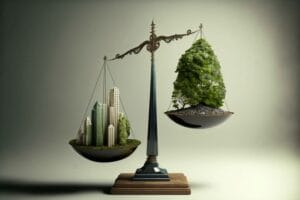 I’ll start by saying that I’ve been talking for several years about the importance of embedding sustainability into management systems. This includes finding a better balance between business, society, and the natural world. Especially since ISO 9001 introduced the concept of Context of the Organisation in 2015. So, I’m really pleased to see this latest development.
But while this may be true, there is more to the story of why ISO included climate notations across most Standards and understanding this context will help you appreciate this new approach. Especially why ISO introduced these amendments were introduced in September 2024 rather than waiting for the next version of specific Standards to be released.
In short, ISO added two sentences to clauses 4.1 and 4.2 within the Context of the Organisation:
Although these additions appear small, the word ‘shall’ in the first clause means organisations must consider climate change. Otherwise, failure to address it will result in unwanted non-conformities.
Well it certainly wasn’t a knee jerk reaction. Developments leading to the publication of these additions in September 2024 started with the London Declaration in September 2021. Subsequently in early 2024, ISO and the IAF published a joint declaration to include these clauses in the core “Annex SL” framework.
Thus promoting the importance of integrating climate change considerations into many management systems with some saying it reflects a global shift toward sustainability and resilience in organisational practices.
For businesses, the new clauses open the door to stronger strategy and risk management practices with climate change no longer being just an environmental concern. It becomes a strategic issue that affects resilience, supply chains, and performance. Especially for any forward-thinking businesses.
It is in fact a clever way of opening up these conversations. Because when used correctly, clauses 4.1 and 4.2 shape how organisations define the risks, opportunities, and objectives fundamental to creating robust management systems. That introduce an inclusive culture and a continual improvement mindset focused on long-term sustainable success.
Creating a meaningful strategy that allows them to consider cross-disciplinary value, linking ISO Standard work with ESG, SDGs, and other sustainability initiatives.
A year on from the publication of these climate change notations a clearer picture is emerging in terms of what this means during certification or surveillance audits.
Auditors expect clear evidence that your organisation has considered climate change from the external-internal issues and interested parties’ perspectives, asking questions like:
For standards like ISO14001, this questioning is straightforward. But for ISO9001, ISO45001, ISO27001, and ISO22301, it poses more challenges, especially since businesses have had only a little over a year to update their systems.
Although auditors’ expectations may differ in terms of what evidence they deem acceptable. They will more than likely raise minor non-conformities at either certification or surveillance audits if a business has not taken any action.
A practical way to strengthen your management system is to
Above all, organisations must justify and approve any determination, whether the result is that climate change is relevant or not relevant.
At the very least, organisations should prepare an Environmental Statement outlining climate relevance and reference an initial plan for a more formal approach in the future. Potentially starting with an Environmental Aspects and Impacts evaluation to determine relevant objectives.
Balancing business performance, social responsibility, with the natural world isn’t easy and required more than quick fixes but it’s where the world is heading.
The climate notation changes remind us that ISO standards aren’t just about compliance; they’re about building resilient, future-ready organisations. So, organisations should develop a robust strategy for Sustainable Development.
To learn how to enhance your management system strategy, contact Coaction Solutions to set-up a free 45-minute consultation.
For instance, those in the social enterprise sector have chosen to pursue the social perspective of sustainability. These entrepreneurs are helped by Social Enterprise UK
and elevated by the Social Value Act of 2012. Others have focused on the ‘green economy’, with documentaries such as the Blue Planet, and celebrities including David Attenborough and Greta Thunberg helping to elevate the environmental perspective of sustainability.
In the financial sector, Larry Fink, the CEO at BlackRock, the largest asset management business in the world wrote that, ‘a company cannot achieve long-term profits without embracing purpose and considering the needs of a broad range of stakeholders,’ and Mark Carney, the former Governor of the Bank of England, recently released a book entitled ‘Value(s): Building A Better World For All’, which strengthened the need for a different way of thinking when it comes to the economic aspect of sustainability.
Furthermore, several studies in recent years by Accenture and Deloitte helped to pull these arguments together, concluding that businesses with a clear purpose and value-led culture outperform those that don’t, stating that:
‘Purpose-driven companies witness higher market share gains and grow
three times faster on average than their competitors, all while achieving higher workforce and customer satisfaction.’ (Deloittes 2019)
All these factors help to bring what has been in the background for far too long, into the foreground.
However, the classic model of Economic, Social and Environment (often used to provide the conceptual structure used to approach it), can make it difficult to understand how sustainability applies to the business world, unless you are involved in it daily.
“Meeting the needs of the present without compromising the ability of future generations to meet their own needs.”
(Brundtland Report 1987)
Although common definitions such as that in the Brundtland Report make sense, they don’t clarify the situation.
So maybe a better way especially for micro and small businesses is to consider sustainability in the following way:
‘A sustainable business is an enterprise that has minimal negative impact, or potentially a positive effect, on the society and environment in which it operates.’
(Source Unknown)
We should not forget that sustainability is also about being around for the long- term and being sustainably successful.
There are many organisations involved in shifting mindsets when it comes to a different way of working that involves a more value-based, inclusive approach – such as Doughnut Economics, B-Corp, and Social Value UK.
Although it is worth being aware of these, by far the most powerful approach behind all of them is that of collaboration, working with all stakeholders (e.g. customers, staff, suppliers, communities, and shareholders) to achieve a better future for all.
Let’s look at a few of the initiatives and organisations involved in making a difference in the South West that could help you better understand, and start to be sustainably successful.
Never assume your customers and other stakeholders don’t care about aspects of sustainability just because they don’t ask!
Be aware that some buying decisions are based on what the business shows it cares about, rather than their prices, and many decisions are made long before contact!
Never be put off by the thought your business is too small to make a difference. Imagine the combined impact that 500,000+ micro and small businesses could make in the South West.
Commit your business to shift towards sustainable success by building the
capacity to cope with change as the future unfolds.
As a starting point, why not commit to becoming Net-Zero by a date suitable to you and your business? You don’t have to wait until 2030 to get there, or for policies and fully funded support to arrive from the ‘powers that be’!
Simply take a look at the blog by ‘Work for Good’ for a relatively simple starting point to the United Nations #RaceToZero.
Alternatively, you can read the Dynamic Servers blog post again and start to reduce your digital carbon footprint by deleting some of your archived emails.
In short, by concentrating on what sustainable success looks like for your business, you will by default engage with and embed sustainability in every sense of the word as it applies to your business.
Let’s use the power of influence and work collaboratively with stakeholders to help make a difference in the South West business community, and ultimately the world.
Article by Rob Hines, BSc, MSc, MInstLM and founder of Coaction Solutions
Wessex House, 66 High Street, Honiton, EX14 1PD


