CoAction Solutions
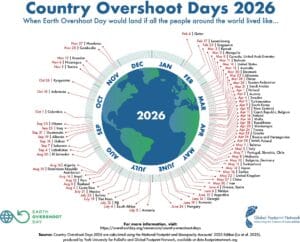
Earth Overshoot Day marks the point when humanity’s demand for ecological resources exceeds what Earth can renew in that year. This year, the date falls on 30th July 2026.
According to the Global Footprint Network, humanity is currently using nature 73% faster than Earth’s ecosystems can regenerate, which is equivalent to using around 1.73 Earths.
Although 30th July is the global date, it varies from country to country. The image shows this difference and is provided courtesy of the “Global Footprint Network -www.footprintnetwork.org and www.overshootday.org.”
It is easy to see this as a climate story. However, while climate change is part of it, Earth Overshoot Day is wider than carbon.
It points to the pressure we place on land, water, forests, food systems, materials, biodiversity and the natural systems that absorb emissions and regenerate the resources our economy depends on.
If Earth Overshoot Day tells us anything, it is that business cannot separate long-term success from the systems it depends on. That does not mean every SME needs a large sustainability department or a complex reporting framework. It means owners and leaders need a clear view of the resource pressures around them and a practical plan for improvement.
For business owners and leaders, Earth Overshoot Day is useful because it gives you a reason to step back and look at the bigger system around your business. Where are you exposed? Where are you wasteful? Where do you depend on scarce resources, fragile suppliers or inefficient processes? Where could better decisions protect value?
Responsible business is often presented as a matter of compliance or reputation. Both can matter, but they are not the whole story. At its best, responsible business helps you run a stronger organisation. It reduces avoidable cost, improves control, supports better planning and builds confidence with the people who matter to your business.
For most SMEs, the response needs to be proportionate. That means starting with the issues most relevant to the size, activities, risks and resources of the business. It is not about copying corporate reporting models or creating paperwork for its own sake. It is about taking practical, credible and proportionate steps that fit the business, support better decisions and can be improved over time.
A useful first step is to ask yourself a few practical questions:
Once you have identified a priority, choose one area of the business where resource use, waste or supply chain risk is visible. Establish a simple baseline. Decide what better would look like. Take action. Review the result. Then adapt and improve. This learn, adapt, improve approach keeps the work realistic and turns sustainability from a separate project into part of how the business operates.
Earth Overshoot Day reminds us that resource use is no longer a background issue. For SMEs, it is also an opportunity. Businesses that use resources more wisely, reduce avoidable waste, strengthen governance and build improvement into everyday routines can become more resilient, more trusted and better prepared for the future.
If creating sustainable success seems like a good move for your business, why not book a free 30-minute discovery call? We can talk through where you are now, what pressures matter most, and what a proportionate next step could look like.
P.S. In the interest of transparency please check out the following links that will provide you with far more explanation than I can do in a simple post.
https://data.footprintnetwork.org/#/ (that provides an interactive view for ecological deficits and so much more)
Wessex House, 66 High Street, Honiton, EX14 1PD